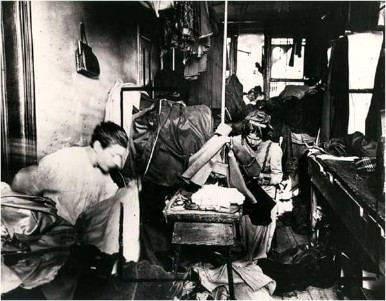
Early in the 19th century as America was at the start of becoming an industrial giant, immigrant workers were attracted to the promise of opportunities. Cunning business men known as “sweaters” created a system whereby they acted as the middleman, directing others in piecework or garment making. They work locations consisted of workers, in crowded, dangerous, low-paying positions. Though the working conditions were miserable it provided many of the new arrivals a transition into American society with the promise of a more prosperous life.
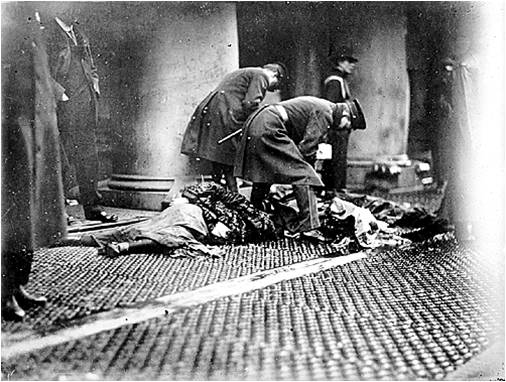
On March 25, 1911 the Triangle Shirtwaist Factory suffers what has become known as one of the greatest industrial tragedies of the 19th Century. The fire consumed the lives of 146 immigrant factory workers, trapped, due to locked exits and a stalled elevator in a burning sweatshop. Many of the deceased jumped from windows, as doors were locked by management as a deterrent for theft. The New York Times, March 26, 1911, p. 1, reported that “Most of the victims were suffocated or burned to death within the building, but some who fought their way to the windows and leaped met death as surely, but perhaps more quickly, on the pavements below.”
Further newspaper reports found that there was only one fire escape in the building. There is just one fire escape in the building, which broke away from the side of the building under the weight of all of the victims that were trying to escape. Others workers jumped from the building to escape the fire, only to meet their death at the end of a fall with no safety net on the concrete.
The factory, owned by Max Blanck and Isaac Harris, manufactured the "shirtwaist” a ready-made white tailored blouse, popular among the working and upper class female. The two owners became known as the “Shirtwaist Kings” at the facility that occupied the eighth, ninth and tenths floors of the Asch Building, at 23-29 Washington Place, on Washington Square East at Greene Street New York, New York.
|
Shirtwaist workers, some as young as the age of 15, often worked 13 hour days, with wages of $6.00 per day. The workers were expected to use their own “needles, threads and often their own sewing machines. Working conditions were unsanitary, with the women having to leave the building to use the restroom. To prevent loss of production time and to deter theft the steel exit doors were locked daily. The foreman was the only person in possession of a key.
The American Federalist reported that the Executive Board of Ladies' Waist and Dress Makers; Union, Local No. 25 met within a few hours of the fire. They realized that although the Triangle Shirtwaist factory was a non union shop, it was their duty to their to provide for aid for a “working class calamity.” They did so in three stages: “relief, protest and prosecution.”
Francis Perkins, a Columbia graduate student, hearing the emergency sirens, arrived at the site of the fire only to witness workers actually leaping from the windows. She resolved to make it her personal duty to work for reform of working conditions, especially for women and children. She served on the Committee onSafety of the City of New York As executive secretary for the Committee on Safety of the City of New York, she worked to improve factory conditions.
 |

